
Does Your Resort Actually Support Wellbeing — Or Just Sell It?
- 02 July, 2026
Wellness has become one of the most overused words in luxury hospitality. A cold plunge pool and a menu of herbal teas does not make a resort a wellness destination. Neither does a spa with a Himalayan salt wall. What determines whether a guest leaves a property feeling genuinely restored — or merely relaxed in the way that a good hotel bed and two cocktails would achieve anyway — is almost entirely decided before the interior designer specifies a single finish. It is decided in the architecture.
This is a distinction the industry is only beginning to reckon with seriously, and it matters for developers because the gap between a resort that markets wellness and one that delivers it is becoming visible to guests in a way it wasn't five years ago.
The Problem With Wellness as a 'bolt-on'
The dominant model for wellness in resort development is additive. A developer commissions a standard luxury brief — rooms, restaurant, pool, beach — and then layers wellness programming on top. A yoga pavilion here. A treatment room there. A "wellness menu" in the spa brochure.
The problem is that by the time those decisions are being made, the architectural moves that would actually support guest wellbeing have already been locked in — or more accurately, missed. The relationship between interior space and natural light across the day, cross ventilation. The acoustic separation between social and private areas. The threshold experience between the outside world and the property. These are not interior design decisions. They are structural ones, made at concept stage, and they are almost impossible to retrofit. I'd go so far to say that you can have a wellness-focussed hotel with no spa that out performs a hotel with a great spa that isn't wellness-focussed when it comes to rest and rejuvination: A resort can have an exceptional spa and guest rooms that work against recovery. Poor acoustic separation between units means light sleepers are woken by neighbouring terraces. East-facing rooms flood with light at 6am whether the guest wants to wake or not — or west-facing rooms trap heat through the afternoon, making the hour before dinner uncomfortable. Corridors designed for efficiency rather than decompression mean guests move through the property in a functional rather than restorative state. None of these failures appear on a wellness menu. All of them shape the guest experience more profoundly than any treatment.
What Light Actually Does
Light is the single most powerful environmental variable in human wellbeing, and it is the one most casually handled in resort design. The science is not new — circadian rhythms, the role of blue-spectrum light in suppressing melatonin, the relationship between natural light exposure and sleep quality — but its application in hospitality architecture remains superficial in most projects.
The intuitive response is to maximise glazing and call it done. More glass, more light, more connection to the landscape. But uncontrolled light is not the same as considered light. A room with floor-to-ceiling east-facing glazing and no external shading device is not a wellness room — it is an alarm clock with a sea view. A restaurant with no solar control on its western elevation becomes unusable at sunset for half the year. A spa treatment room with borrowed light from a busy corridor has the right aesthetic intention and entirely the wrong result.
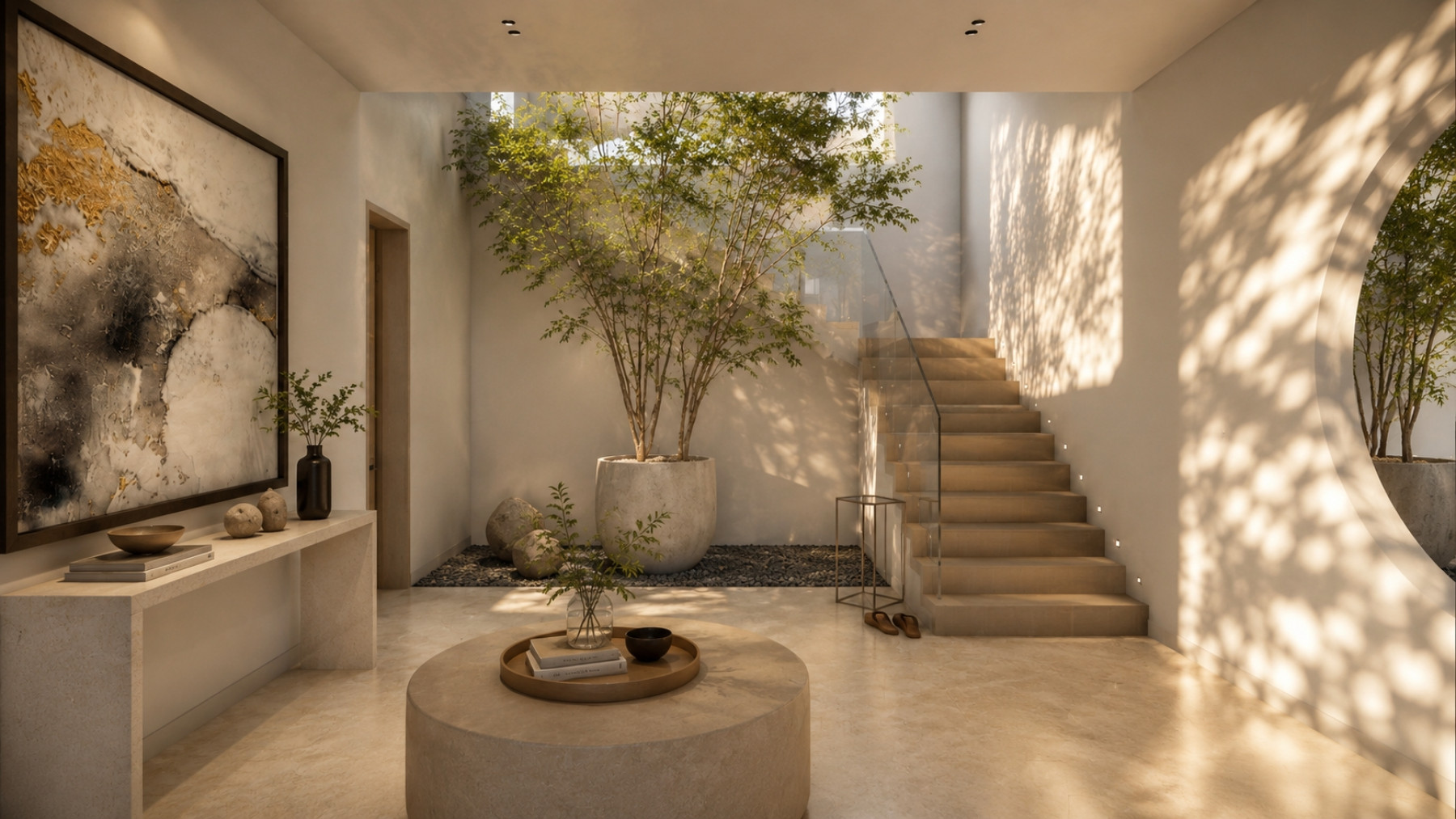
Considered light design in a resort context means understanding the arc of the sun across the site across all seasons, designing shading as architecture rather than afterthought, and calibrating artificial lighting for time of day rather than defaulting to a single scene. It means east-facing rooms with controllable solar shading so the guest chooses when to let the morning in. It means transition zones; arrival sequences, corridors, thresholds, lit at a lower intensity than social spaces so the nervous system is gently cued toward rest as guests move toward their rooms. We have software to predict this, and dare I say it - AI is now making this process a lot quicker.
In TCI, the environmental conditions make this both more important and more achievable than almost anywhere else. The light quality here is exceptional. The sun path is predictable. The opportunity to design genuinely with natural light rather than relying on artificial systems to compensate for a poorly oriented building is one of the most underused assets in Caribbean resort development.
The Acoustic Dimension
Wellness in hospitality is almost always discussed in visual terms. Light, materials, landscape, view. Acoustics is the dimension that is felt rather than seen, which means it is under-specified in briefs and under-valued in value engineering — and disproportionately damaging when it fails.
A guest who cannot sleep because of noise transfer between units, or who cannot relax on their terrace because they can hear the adjacent villa's conversation, has not had a wellness experience regardless of what the marketing promised. In timber-frame or lightweight construction this is a fundamental structural challenge. In concrete construction (the dominant method in TCI) it is a solvable problem at design stage that becomes an expensive retrofit problem if ignored until construction.
Acoustic separation between units, between social and private zones within a unit, and between the property and its external environment should be a design constraint from the first massing study. In practice it is rarely raised before the building is under construction.
What Honest Wellness Design Actually Requires
A resort that genuinely supports guest wellbeing is not a different type of resort. It is a more considered version of the same brief, with the following non-negotiable design priorities embedded from concept stage:
Orientation — rooms and social spaces positioned relative to the sun path with intention, not just view corridors and site efficiency.
Environmental performance — thermal comfort achieved through building form, shading, and natural ventilation as primary strategies, with mechanical systems as support rather than the solution. BREEAM-informed design thinking, even where formal certification is not pursued, provides a useful framework for embedding these priorities early.
Light control — solar shading designed as architecture, artificial lighting calibrated for time of day and human circadian response.
Acoustic integrity — separation between units and between programmatic zones treated as a structural requirement, not a fit-out afterthought.
Threshold design — the arrival sequence, the transition from public to private, and the approach to each guest room treated as decompression choreography rather than circulation efficiency.
None of these require a wellness consultant. They require an architect who asks the right questions at the right stage of the project — and a developer who understands that the most important wellness decisions are made before the spa operator is appointed.
The Honest Position
As a practice, we have always considered environmental performance, light, and the relationship between space and human experience as core design drivers rather than optional layers. In a market where wellness is increasingly a development differentiator, the question worth asking is not which operator to bring in for the programming — it is whether the building itself will support what the programming promises. Furthermore, record the process, let your guests know every detail has been considered before foundations were poured so they know they are in the best hands.
If this was helpful…
✍️ Follow @dune.design.tci for more tips!